Sunday, 31 January 2016

Sonderkommando Elbe. Compiled by Cesar Winkelmann

Colonel Hans Joachim " Hajo " Hermann
On 7 April 1945, a group of 180 Messerschmitt bf 109 fly on Germany's skies, however, they are not armed, their mission is: rammed against the American bombers. This bold tactic of the Luftwaffe was created by Colonel Hans Joachim " Hajo " Hermann; a desperate attempt to regain control of the sky.
  The American bombers killed many civilians mainly in Dresden, which led to Luftwaffe take extreme measures. The main objective of the mission was: ramed and scare the American bombers to the point that they stop up the bombers by 4 or 6 months, which would be enough to to build Messerschmitt Me 262 top models, the first Luftwaffe´s jet plane to recover the domain of the sky.


Friday, 22 January 2016

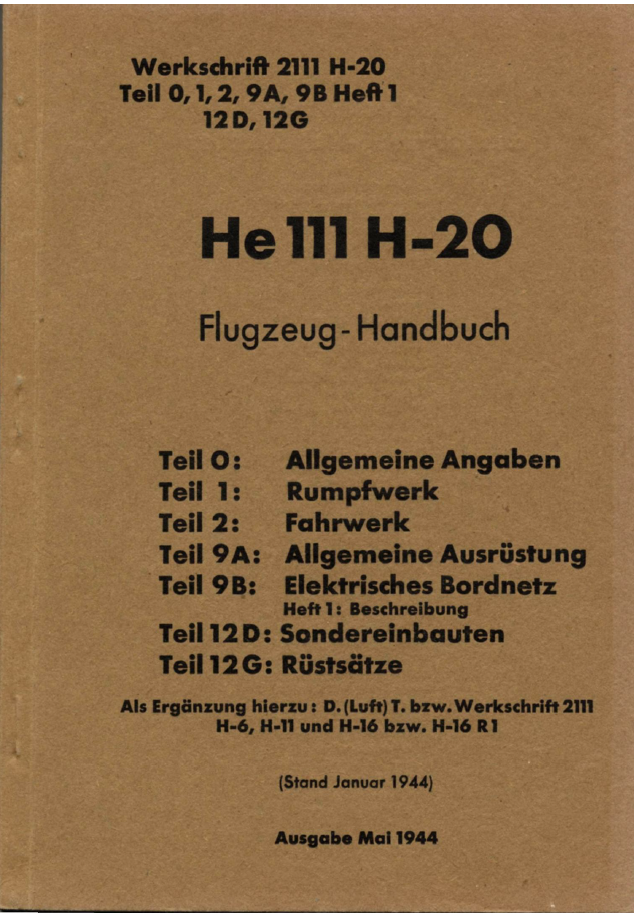
Flugzeug-Handbuch He 111 H-20 Teil 12A

Flugzeug-Handbuch He 111 H-20 Teil 12A: LINK

Flugzeug-Handbuch He 111 H-20 Teil 12 B

Flugzeug-Handbuch He 111 H-20 Teil 12 B: LINK

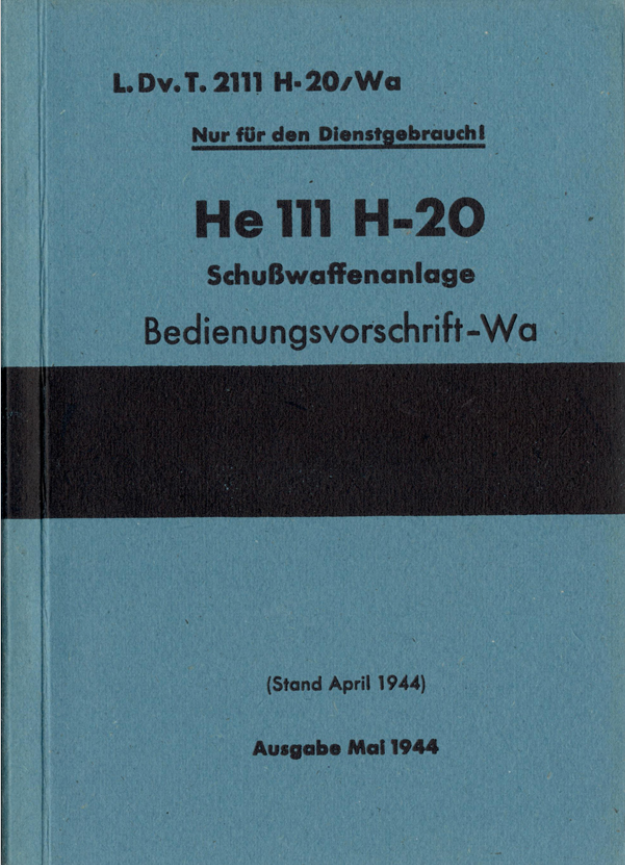
Schuẞwaffenanlage H111 H-20 Wa

Schuẞwaffenanlage H111 H-20 Wa: LINK

Flugzeug-Handbuch H111 H-20

Flugzeug-Handbuch H111 H-20: LINK

Schusswaffenanlage Heinkel He 111 H-11, H-14 und H-16

Schusswaffenanlage Heinkel He 111 H-11, H-14 und H-16: LINK

Alphabetical list of Luftwaffe airfields (1939-1945) on the territory of contemporary Poland. Part 3: O-Z. Compiled by Alex Halley

Part 3 of Luftwaffe airfields list. Today letter from O to Z. If you find any mistake or wrong information, please feel free to correct Us with  your information. If you have possibility to extend these list, please, don't delay .
In preparation is a map with marked locations. Coming soon.

Set of 3 documents about Heinkel He111

Bedienungsvorschrift Heinkel He111 D-ASAR Siemens: LINK


Kurz.Anleitugng He111HPD: LINK


Schemas He111 P: LINK

Thursday, 21 January 2016

Alphabetical list of Luftwaffe airfields (1939-1945) on the territory of contemporary Poland. Part 2: H-N. Compiled by Alex Halley

Part 2 of Luftwaffe airfields list. Today letter from H to N. If you find any mistake or wrong information, please feel free to correct Us with  your information. If you have possibility to extend these list, please, don't delay .
In preparation is a map with marked locations. Coming soon.

Wednesday, 20 January 2016

Heinkel He111 H16 Handbuch

Heinkel He111 H16 Handbuch: LINK

Alphabetical list of Luftwaffe airfields (1939-1945) on the territory of contemporary Poland. Part 1: A-G. Compiled by Alex Halley


Part 1 of Luftwaffe airfields list. Today letter from A to G. If you find any mistake or wrong information, please feel free to correct Us with  your information. If you have possibility to extend these list, please, don't delay . 
In preparation is a map with marked locations. Coming soon.

Tuesday, 19 January 2016

The Story of Heinkel He111. Armament. Part 6. German Dzib -Compiler-


MG 15 in left beam mounting inside a Ju 52, and above it storage brackets for 12 MG 15 magazines, with one magazine mounted.

Guns

MG 15

he MG 15 was a German 7.92 mm machine gun designed specifically as a hand manipulated defensive gun for combat aircraft during the early 1930s. By 1941 it was replaced by other types and found new uses with ground troops.

History

The MG 15 was developed from the MG 30 which was designed by Rheinmetall using the locking system invented by Louis Stange in the mid to late 1920s. Though it shares the MG 15 designation with the earlier gun built by Bergmann, the MG 15nA (for neuer Art, meaning new model having been modified from an earlier design) has nothing in common with the World War II gun except the model number. The World War I gun used a tipping lock system while the WWII aircraft gun uses a rotating bolt/lockring. The World War II MG 15 was used in nearly all Luftwaffe aircraft with a flexible-mount defensive position.

Sunday, 17 January 2016

Heinkel He 111 H-6 - Paper model plans, just for Fun :)

Heinkel He 111 H-6. Paper model plans. : LINK

Kurzbetriebsanleitung He 111P - Brief instructions He 111P

Kurzbetriebsanleitung He 111P : LINK

Leonidas - 5th Staffel of Kampfgeschwader 200. Compiled by Cesar Winkelmann


Fieseler Fi103R
By mid-1944, the Fi-103 (V-1) had been deployed to special units in Germany and in the occupied countries for attacks against the British Isles. It was a simple weapon, a streamlined airframe carrying an explosive warhead on which an Argus AS-109 pulsejet was mounted. The pulsejet was equally simple; a tube lacking both turbine and compressors into which vaporized fuel was injected in spurts and ignited. Shutters at the front of the tube opened to admit air during the intake phase and closed during the ignition phase to direct the combustion gases to the rear. It had very few moving parts, was simple to make and easy to maintain.

Heinkel He111. Powerplant. Part 5. German Dzib -Compiler-


Powerplants

He111 H-6

Junkers Jumo211

The Jumo 211 was an inverted V-12 aircraft engine, Junkers Motoren's primary aircraft engine of World War II. It was the direct competitor to the famous Daimler-Benz DB 601 and closely paralleled its development. While the Daimler-Benz engine was mostly used in single-engined and twin-engined fighters, the Jumo engine was primarily used in bombers such as Junkers' own Ju 87 and Ju 88, and Heinkel's H-series examples of the Heinkel He 111 medium bomber. It was the most-produced German aero engine of the war, with almost 70,000 examples completed.

Saturday, 16 January 2016

The story of Heinkel He111. Production and variants. Part 4. Dzib German -Compileer-


Production


He 111 production in 1939
To meet demand for numbers, Heinkel constructed a factory at Oranienburg. On 4 May 1936, construction began, and exactly one year later the first He 111 rolled off the production line. (63) The Ministry of Aviation Luftwaffe administration office suggested that Ernst Heinkel lend his name to the factory. The "Ernst Heinkel GmbH" was established with a share capital of 5,000,000 Reichsmarks (RM). Heinkel was given a 150,000 RM share. (63)  The factory itself was built by, and belonged to, the German state. (63)

Tuesday, 12 January 2016

The Story of Heinkel He111. Military variants. Part 3. German Dzib -Compiler-

Military variants

He 111 A - D

The initial reports from the test pilot, Gerhard Nitschke, were favourable. The He 111's flight performance and handling were impressive although it dropped its wing in the stall. As a result, the passenger variants had their wings reduced from 25 m (82 ft) to 23 m (75 ft). The military aircraft - V1, V3 and V5 - spanned just 22.6 m (74.1 ft). (17) The prototypes were equipped with 431 kW (578 hp) BMW VI 6.0 V12 in-line engines, succeeded by745 kW (999 hp) DB 600 engines. (17) The first prototypes were underpowered, as they were equipped with 431 kW (578 hp) BMW VI 6.0 V12 in-line engines. This was eventually increased to 745 kW (999 hp) with the fitting of the DB (Daimler-Benz) 600 engines into the V5, which became the prototype of the "B" series. (17)
A Chinese He 111A re-engined with Wright Cyclone radial engines.
Only 10 He 111 A-0 models based on the V3 were built, but they proved to be underpowered and were eventually sold to China. The type had been lengthened by 1.2 m (3.9 ft) due to the added 7.92 mm (.312 in) MG 15 machine gun in the nose. Another gun position was installed on top of the fuselage, and another in a ventral position as a "dustbin" exposed turret, which could retract. The bomb bay was divided into two compartments and could carry 680 kg (1,500 lb) of bombs. The problem with these additions was that the weight of the aircraft reached 8,200 kg (18,080 lb). The He 111's performance was seriously reduced; in particular, the BMW VI 6.0 Z engines were not now powerful enough. The increased length also altered the 111's aerodynamic strengths and reduced its excellent handling on takeoffs and landings. (22)

Monday, 11 January 2016

Heinkel He111 H P D Bedienungsvorschrift Schusswaffe - He111 H P D provision Operation Gun

Heinkel  He111 H P D Bedienungsvorschrift Schusswaffe: LINK

Heinkel He111 Vorleaufige Montage und Betriebsanleitung - Heinkel He 111 Preliminary assembly and operating instructions

Heinkel He111 Vorleaufige Montage und Betriebsanleitung: LINK

Erprobungsbericht Heinkel He111 H-11 LT - The report studies Heinkel He 111 H-11 LT

Erprobungsbericht He111 H-11 LT: LINK

Story of Heinkel He111. Part 2. German Dzib -Compiler-


Basic design


Picture 1
The design of the He 111 A-L initially had a conventional stepped cockpit, with a separate pair of windscreen-like panels just for the pilot and co-pilot. The introduction of the P variant meant that the He 111P and following production variants were fitted with a fully glazed "bullet" or "fishbowl"-like, laterally asymmetric nose, with the port side having the greater curvature for the pilot, off setting the bombardier to starboard. The resulting "steeples cockpit", which was a feature on the majority of German bomber designs during the war years in varying shapes and formats, no longer had the separate windscreen panels for the pilot, who now had to view their exterior flight environment through the same bullet-like glazing that was used by the bombardier and navigator. Within the cockpit the pilot was on the left and the navigator/bomb aimer on the right. The navigator went forward to the prone bomb-aiming position, or could tilt his chair to one side so that he could move into the rear of the aircraft. There was no cockpit floor below the pilot's feet - the rudder pedals being on arms - giving very good visibility below. (14)

Saturday, 9 January 2016

Story of Heinkel He111. Part 1: The Begining.German Dzib -Compiiler-


When World War I ended, the German Air Force was disbanded under the Treaty of Versailles, which required the German government to abandon all military aviation by October 1, 1919. However, by 1922, it was legal for Germany to design and manufacture commercial aircraft, and one of the first modern medium bombers to emerge from this process was the Heinkel He 111, the first prototype of which an enlarged, twin-engine version of the single-engine mail-liaison He 70, which set 8 world speed records in 1933 flew in February of 1935. The second prototype, the He 111 V2, had shorter wings and was the first civil transport prototype, capable of carrying 10 passengers and mail. The third prototype, He 111 V3 also had shorter wings and was the first true bomber prototype. Six He 111 C series airliners were derived from the fourth prototype, the He 111 V4, and went into service with Lufthansa in 1936, powered by a variety of engines, including BMW 132 radials. The first production models had the classic stepped windshield and an elliptical wing, which the designers, Siegfried and Walter Gunter, favored. As a military aircraft, it took longer to gain favor, because military load requirements and underpowered engines kept its cruising speed down to less than 170 mph. However, in early 1936, the plane was given 1,000 hp Daimler Benz DB 600A engines which improved performance dramatically enough to bring in substantial orders. The first two mass-production versions, He 111 E and He 111 F experienced great success during the Spanish Civil War, where they served with the Condor Legion as fast bombers, able to outrun many of the fighters sent against them.

Thursday, 7 January 2016

Act of kindness. Story based on the Book "A HIGHER CALL"


Stuka lies upside down.

A Ju-87 Stuka bomber lies upside down in a marsh in the vicinity of Leningrad. The inverted gull wings and fixed spatted undercarriage are clearly visible. One of the two-man crew lies in the foreground. This was an attempt at forced landing which didn't work because of the marshy ground. Sept 1943


Sunday, 3 January 2016

Saturday, 2 January 2016

Blohm und Voss Bv155 – strange and beautiful high-altitude interceptor. Part 1. Compiled by Alex Halley


Backround

When we look at the history of Blohm und Voss Bv155, we can see two seemingly independent events that had significant influence on the creation of this warbird. The first was a slow-growing aircraft project. The other one, independent constructional works of the leading companies of the advanced interceptor who handle at high altitudes. Another side of the story shows that the German war machine wasn’t perfect at all, even in the early stages of the war. Decisions of the RLM levels not always proved to be spot-on, and focuses on the right projects commissioned too late in the face of crushing hugs the eastern and western front. If German successfully realized Bv155 project and couple others, as Dornier Do335, or make production of Me262 truly massive, the fate of the war would have been different? Maybe, definitely the situation for the III Reich would look preferred.