Showing posts with label World War II. Show all posts

Wednesday, 5 April 2017

3D MODELING: Henschel Hs129 B-3, engine Gnome Rhone 14N by Wojciech Nieweglowski. Part 4

Check full album HERE.

Gnome Rhone 14N, follow the Wiki:

"The 14N was a 14-cylinder two-row air-cooled radial engine designed and manufactured by Gnome-Rhône. A development of the pre-war Gnome-Rhône 14K, the 14N was used on several French and German aircraft of World War II."


Wednesday, 9 November 2016

Luftwaffe Ace Pilot: Hermann Graf


"German Luftwaffe members Erich Hartmann, Adolf Galland and Johannes Steinhoff achieved a measure of immortality for their flying and fighting prowess during World War II. A name missing from many histories of that conflict, however, is Hermann Graf — with 212 confirmed victories, one of the most decorated aces in the Luftwaffe.

Born on October 12, 1912, in Engen im Hegau, Germany, Hermann was the youngest of three sons. Aviation fascinated him from his youth; he was only 12 when he made his first glider flight. While still in school, Graf earned his ‘A,’ ‘B’ and ‘C’ glider certificates. According to Christer Bergström, author of Graf & Grislawski: A Pair of Aces, young Graf first worked as a locksmith apprentice, then later as a public assistance clerk apprentice. Many accounts incorrectly report he apprenticed as a blacksmith, emulating his father.

Tuesday, 18 October 2016

Sunday, 9 October 2016

Set of photos: The Battle of Crete - Operation Mercury/Unternehmen Merkur, May/June 1941

Set of photos from Crete, May/June 1941:


Messerschmitt Bf110 downed by RAF fighters over Lulworth in Dorset during a Battle of Britain in August 1940

The text is copied from culture24 and published by Richard Moss at 08 September 2014

'Archaeologists find remains of German Messerchmitt downed during Battle of Britain dogfight

The remains of a Messerchmitt Bf 110, shot down during a Battle of Britain dogfight, have been unearthed during a dig at Lulworth in Dorset.

The graves of Luftwaffe personnel Gunter Beck and Georg Lammel
at Portland Royal Naval cemetery
An archaeological dig at a Ministry of Defence site near Lulworth in Dorset has uncovered evidence of a German Messerschmitt Bf 110 heavy fighter that was downed by RAF fighters during the Battle of Britain in August 1940. 

Large quantities of material, including fragments of propeller, Daimler Benz engines, ammunition, parts of the perspex canopy and other elements were uncovered by a team working at the Lulworth Ranges as part of Operation Nightingale, a groundbreaking initiative that uses field archaeology to aid the recovery of service personnel injured in conflict.

Tuesday, 4 October 2016

"The Stuka", "Ernst udet - the Devil's General", "Field Marshal Hugo Sperrle" - documentaries and archive

"The Stuka -  Scorched Earth" S1⁄E3
 "Hitler's Warriors - Ernst Udet, The Devil's General"
 
Silence film recorded by unknown Luftwaffe soldier on airfield during visit of Field Marshal Hugo Sperrle - Germany, 1940

Thursday, 29 September 2016

Italian documentary of Luftwaffe equipment - Part 1

"Junkers Ju52 Tante Ju - Italian documentary"
 
 
"Junkers ju87 Stuka - Italian documentary"


"Junkers Ju88 - Italian documentary"
 

Saturday, 17 September 2016

Günther Rall, Wilhelm Kriessmann, Erich Hartmann, Hans Meyer - video clips, interviews

Luftwafe Ace Hans Meyer

Luftwaffe Ace Erich Hartmann

Luftwaffe Ace Günther Rall - Interview

Interview with Luftwaffe pilot Wilhelm Kriessmann - Interviewed by Rodney Martin

Thursday, 17 March 2016

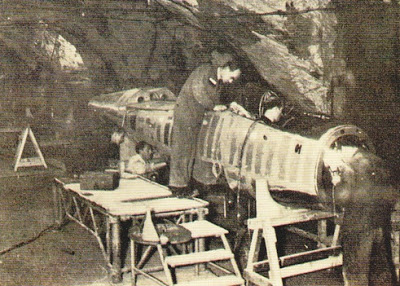
Hatchery of Salamander - underground factory of heinkel He162 at Hinterbrühl

Heinkel He162 during production process in underground
factory at Hinterbrühl
In 1944 Ernst Heinkel went on a search for a bombproof production site for the  He162 "Salamander", the choice fell on the lake grotto. The underground lake was drained, the floor filled with concrete and the necessary equipment installed (lighting, heating, ...)
Despite the terrible situation as a whole in 1944/45 could be made in the tunnels 198 fuselages of the "People's hunter". Employees were over 2000 people, including 1700 KZ prisoners from KZ Hinterbrühl. The final assembly was carried out in Schwechat - Heidfeld in Heinkel factory at today's airport

Saturday, 27 February 2016

Interview with Adolf Galland -1994.

"He who wants to protect everything, protects nothing," is one of the fundamental rules of defense.
Adolf Galland

Adolf Galland during the Spanish
Civil War, in which he flew
Heinkel He-51 biplanes,
more often on strafing missions
 than in aerial combat.
This article was written by Colin D. Heaton and originally appeared in the January 1997 issue of World War II (taken from HistoryNet).

"When historians speak of pilots and the history of air combat, certain names invariably come up sooner or later–Manfred von Richthofen, Edward Mannock, René Fonck, Erich Hartmann, Alexander Pokryshkin, Johnny Johnson, Dick Bong… and Adolf Galland. Galland was the youngest general grade officer of either side in World War II, and at age 29 he was more competent in aerial combat, strategy and tactics than many of the experts nearly twice his age. Galland fought a hard battle against his superiors on the ground, which made the danger in the air inviting, almost welcome. Adolf Hitler and Luftwaffe Chief Hermann Göring, who were always trying to find fault and place the blame on others for their own failures, began pointing fingers at the fighter pilots. Was it not they who failed to stop the death and destruction delivered by Allied bombers? Was it not the fighter pilots who demanded more of the resources and new technology, yet produced the least results? Göring betrayed his pilots and publicly denounced them as cowards, provoking the Fighters’ Revolt in January 1945.